 Fulfilled
One Column Page
and responsive to boot
The Millennium - Between the Two Great Revolts
by
Adam Maarschalk
This article appeared in the 2026 Spring issue of Fulfilled! Magazine
Revelation 20:10, which serves as the foundation of several major eschatology systems, is a passage that many have rightfully found to be challenging. However, a number of contextual clues point well to the 1000 years beginning around AD 70 and slotting between two major wars. These hints include Satan’s capture in connection with the capture of the beast and false prophet (the three who spearheaded the first war); Satan deceiving the nations two separate times; the identity of those who came to life and reigned with Christ for 1000 years; how they would overcome beforehand; the size of Gog and Magog’s army; the significance of the camp of the saints in the beloved city and the fire from heaven that devoured their persecutors; and the beast and false prophet preceding Satan to the lake of fire.
In the following verse-by-verse study of this 10-verse passage, I propose that the 1000 years took place between the two great Jewish revolts against Rome, i.e., from about AD 73 to AD 132, and that the Second Great Revolt (AD 132-135) was Satan’s short time of release. All Scripture texts in this study are from the New American Standard Bible (NASB).
Revelation 20:1-2
“Then I saw an angel coming down from heaven, holding the key of the abyss and a great chain in his hand. And he took
hold of the dragon, the serpent of old, who is the devil and Satan, and bound him for a thousand years” (Rev 20:1-2).
An angel comes down from heaven to capture the dragon, also known as “the devil” and “Satan,” to bind him for 1000 years. Of course, this happens for a reason. Satan’s activity is revealed in Revelation 12, 13, and 16, particularly his empowering of the beast and the false prophet. How does Satan’s penalty differ from his “partners in crime,” and why is this significant?
The most immediate context of Revelation 20 is Revelation 19. At the end of chapter 19, the beast led a coalition to make war against Jesus and His army. The end result (fulfilled in AD 70, I believe) was that the beast and false prophet were seized and thrown into the lake of fire:
“And the beast was seized, and with him the false prophet who performed the signs in his presence, by which he deceived those who had received the mark of the beast and those who worshiped his image; these two were thrown alive into the lake of fire…” (Rev 19:20).
This was followed by “the rest” being killed by the sword of Jesus and fed to the birds (Rev 19:21). I believe this includes the final half of the Jewish-Roman War, up to the final stand at Masada in AD 73.
There was one more entity who needed to be captured: Satan. Although the beast and false prophet were thrown into the lake of fire, a different outcome was reserved for the third member of “the unholy trinity”1 that spearheaded the war against Jesus and His army, a picture that emerges clearly in Revelation 12-13 and 16:
“And the great dragon was thrown down, the serpent of old who is called the devil and Satan, who deceives the whole world…” (Rev 12:9).
“Then I saw a beast… And the dragon gave him his power and his throne, and great authority… they worshiped the dragon because he gave his authority to the beast…” (Rev 13:1-4).
“Then I saw another beast… He exercises all the authority of the first beast in his presence… He performs great signs…” (Rev 13:11-13).
“And I saw coming out of the mouth of the dragon, and out of the mouth of the beast, and out of the mouth of the false prophet, three unclean spirits like frogs; for they are spirits of demons, performing signs, which go out to the kings of the entire world, to gather them together for the war of the great day of God, the Almighty… And they gathered them together to the place which in Hebrew is called Har-Magedon” (Rev 16:13-16).
Upon this war’s failure, Satan was the only one of these three assigned to the abyss (Rev 20:1-2). The following verses will reveal why. In summary, though, Revelation 19:20-20:2 appears to cover the capture of the major players in the war against Jesus and the saints.
Regarding 1000 years as represented by approximately 60 years (AD 73 – AD 132), Ecclesiastes 6:1-6 serves as an illustration of how the number “1000” can be hyperbole for a long period of time: “…If a man fathers a hundred children and lives many years… Even if the man lives a thousand years twice, but does not see good things…” The idea of a man living for 2000 years (aside from being the logical conclusion of the futurist stance on Matthew 16:28) is clear hyperbole. For a more extensive treatment of numeric hyperbole in the Scriptures, see the beginning of Robert Cruickshank, Jr.’s article in the Winter 2025 issue of Fulfilled! Magazine.2
Revelation 20:3
“And he threw him into the abyss and shut it and sealed it over him, so that he would not deceive the nations any
longer, until the thousand years were completed; after these things he must be released for a short time” (Rev 20:3).
Satan was thrown into the abyss, which was shut and sealed over him for 1000 years, the purpose of which was to keep him from deceiving the nations any longer until his eventual release to do so once again for a short time. The words “any longer” make it clear that he was caught red-handed deceiving the nations prior to the 1000 years. Indeed, this is what he was doing when John wrote the book of Revelation (perhaps around AD 65): “…Satan, who deceives the whole world…” (Rev 12:9). This is also a fitting reference to how he deceived the nations to war (Rev 16:13) during the First Great Revolt (AD 66-73). These nations included Judea, Samaria, Galilee, Idumea, and Perea; consider also the Jewish diaspora as they took their marching orders from Jerusalem (Rev. 17:1-2, 15).
The nature of Satan’s deception prior to the 1000 years is not stated in verse 3. However, his release afterward would have a singular purpose: to deceive the nations by gathering them to war (Rev 20:7-8). Because he was sealed in the abyss to keep him from deceiving the nations “any longer,” but only temporarily because he would be released to do it again, his purpose for deceiving the nations before the 1000 years was likely the same as it would be afterward.
The two great revolts (AD 66-73 and AD 132-135) account well for two separate times of deceiving the nations to war. We will discuss the Second Great Revolt (AD 132-135) in detail when we come to verses 7-10.
Revelation 20:4
“Then I saw thrones, and they sat on them, and judgment was given to them. And I saw the souls of those who had been
beheaded because of their testimony of Jesus and because of the word of God, and those who had not worshiped the beast
or his image, and had not received the mark on their foreheads and on their hands; and they came to life and
reigned with Christ for a thousand years” (Rev 20:4).
John was then shown the role of the faithful during the same 1000-year time period: to sit on thrones and judge with Christ. Several other passages speak of Jesus sitting on His throne with the saints: Daniel 7:7-11, 7:23-27; Matthew 19:27-28, 25:31; Revelation 3:21. Collectively, these passages show that, before the saints sit on thrones to judge, Christ comes in judgment, the beast is defeated, the resurrection takes place, and the saints inherit the kingdom (events that took place around AD 70). Consequently, the setting up of thrones for Jesus and His followers to reign and judge, i.e., the beginning of the 1000 years, best fits the AD 70 timeframe when Jesus came in judgment and in His kingdom.
Revelation 20:4 grants the privilege of sitting on thrones with Jesus to those who overcame. Before noting exactly what they overcame, let’s consider two other texts in Revelation that promise similar honors to those who overcome until the end:
“The one who overcomes, and the one who keeps My deeds until the end, I will give him authority over the nations; and he shall rule them with a rod of iron…” (Rev 2:25-26).
“The one who overcomes, I will grant to him to sit with Me on My throne, as I also overcame and sat with My Father on His throne” (Rev 3:21).
In Revelation 2:26-27, 3:21, and 20:4, the order is clear: [1] overcome until the end [2] rule with Jesus on His throne. Revelation 20:4 reveals what the faithful ones would overcome before reigning with Christ for 1000 years: “…those who had been beheaded because of their testimony of Jesus…those who had not worshiped the beast or his image, and had not received the mark on their foreheads and on their hands.” These details are directly and explicitly parallel to Revelation 13:4-17.
“…and they worshiped the beast… And he makes the earth and those who live on it worship the first beast… telling those who live on the earth to make an image to the beast… (Rev 13:4, 12, 14).
“…and cause all who do not worship the image of the beast to be killed” (Rev 13:15).
“And he causes all, the small and the great, the rich and the poor, and the free and the slaves, to be given a mark on their right hands or on their foreheads…” (Rev 13:16).
Revelation 20:4, therefore, draws unmistakably from Revelation 13 in describing who would reign with Christ for 1000 years: those who were martyred by the beast who made war on the saints for 42 months (Rev 13:5-7). This is confirmed by the words “had been beheaded” (past perfect verb tense) and “came to life” (resurrected). These beheadings occurred from AD 66-70 when the Zealots, false prophets, and Idumeans cut the throats of those who opposed their war agenda (Josephus, Wars 2.18.3, 4.5.3, 5.8.1, 5.10.1).
Thus, the beginning of the 1000 years awaited the martyrdom of those who overcame the beast, as the only named participants were those who refused to worship the beast and take his mark. One may question if the millennial reign is limited to these faithful martyrs from the great tribulation, but it certainly could not exclude them or begin without them. Just as the song of Moses was reserved for “those who were victorious over the beast and his image and the number of his name” (Rev 15:2-4), the 1000-year reign with Christ was also reserved for those who gained this victory.
Revelation 20:5
“The rest of the dead did not come to life until the thousand years were completed. This is the first
resurrection” (Rev 20:5).
Textual critics are divided on whether Revelation 20:5a (“The rest of the dead did not come to life until the thousand years were completed”) was in the original text. Jonathan Sedlak, an independent preterist scholar, published a study in 2022 titled “Rethinking Revelation: A Thousand Years Without 20:5a.”3 Sedlak states that Revelation 20:5a is an “unusually lengthy textual variant” that “is not found in some of the oldest, best, and most widely attested manuscript traditions available today” and is most likely “a later scribal addition” (p. 2).
The “wide variety of witnesses attesting to its omission” from the original text, he adds, include older sources like the Codex Sinaiticus (earliest known Greek manuscript), the Peshitta and Harclean (“ancient and authoritative Syriac text-types”), the Latin commentary by Victorinus (AD 258-260), and the reconstructed (late AD 300s) Latin commentary of Tyconius (pp. 19-20). How did the Revelation 20:5a variant make its entrance, if it wasn’t in the original text? Sedlak hypothesizes that it was “an early interpolation that spread throughout the western regions of Christendom, popularized heavily by Andrew of Caesarea’s seventh-century commentary on Revelation on one hand, and Latin Vulgate manuscripts on the other, which is where we find its frequent insertion and presumed authenticity among textual witnesses” (p. 21).
G. K. Beale acknowledges the weightier evidence among textual witnesses for the omission of this variant and admits that its inclusion feels “out of place” and “abrupt” (p. 15). New Testament scholar R. H. Charles agrees and notes that the insertion of Revelation 20:5a disrupts the literary structure, but “by its removal the symmetry of the text is restored – seven successive couplets” between verses 4 and 6. Philip Comfort (NT textual scholar) and Daniel Morais see this variant as a scribal gloss, as, respectively, an intentional insertion (Sedlak, 2022, pp. 17-19) or an accidental insertion by “a well-meaning scribe who mistook the marginal statement for a textual omission.”4
If the textual variant is omitted, verse 5 simply notes that the martyrs experienced the first resurrection: “This is the first resurrection.”
Revelation 20:6
“Blessed and holy is the one who has a part in the first resurrection; over these the second death has no power, but
they will be priests of God and of Christ, and will reign with Him for a thousand years” (Rev 20:6).
Three things are noted for those who have a part in the first resurrection:
- They have no concerns about the second death because it has no power over them.
- They would be priests of Jesus and His Father.
- They would reign for 1000 years with Jesus.
Revelation 20:7-8
“When the thousand years are completed, Satan will be released from his prison, and will come out to deceive the
nations which are at the four corners of the earth, Gog and Magog, to gather them together for the war; the number of
them is like the sand of the seashore” (Rev 20:7-8).
As noted earlier, Satan’s 1000 years in the abyss were to keep him from deceiving the nations “any longer” (Rev 20:3), meaning that this is exactly what he was doing before the 1000 years. After his release from “his prison,” he would deceive the nations once more, “to gather them together for the war.”
The two great revolts account well for two separate campaigns of deceiving the nations to war, before and after the 1000 years. Furthermore, the Second Great Revolt, also known as the Bar Kokhba Revolt, featured not only a massive army but also elements similar to the First Great Revolt, including minted coins, Zealot leadership, a high priest and Sanhedrin, and a proposed or actual temple.
The Beginning of the Second Great Revolt
The Second Great Revolt began in early AD 132 and lasted for about 3.5 years until late summer AD 135. It was initiated for several reasons:
- In AD 130, the Roman emperor Hadrian founded the city of Aelia Capitolina in place of Jerusalem and began to build a temple to Jupiter where the Jewish temple had been (Cassius Dio, Roman History 69.12.1).5
- Tineius Rufus, the Roman governor of Judaea, with military aid from Hadrian, engaged in heavy-handed and murderous ways toward the Jews (Eusebius, History of the Church 4.6.1).6
- In early AD 132, Hadrian forbade circumcision for all, including the Jews. Around the same time, his building works caused the collapse of Solomon’s tomb.7
While Hadrian was in Egypt and Syria, the Jews were quiet, but they openly revolted when he left the region (Cassius Dio 69.12.2). “Many outside nations” also joined the Jews in fighting against the Romans, “and the whole earth, one might almost say, was being stirred up over the matter.” In response, Hadrian sent his best generals (Cassius Dio 69.13.2),8 four legions, at least 17 auxiliary units, and parts of other legions – eventually facing a manpower shortage.9
The Leadership of the Second Great Revolt
The leader of the Second Great Revolt was Simon Bar Kokhba. Letters written in his name (dating from April AD 132 to November AD 135) have been found in the Judean desert as recently as 1961. His army of 400,000 soldiers was nearly 10 times the size of the army that faced off against Rome in the First Great Revolt.10 Simon requested for God to “neither assist nor discourage us” in battle.11 According to Eusebius (History 4.6.2), Simon “claimed to be a luminary come from heaven…magically enlightening those who were in misery.”12
Simon’s right-hand man was Rabbi Akiva ben Joseph, president of the rabbinical academy at Yavne and known for perfecting Midrash. According to the Jerusalem Talmud (y. Ta‘an. 4:6 68d), when Rabbi Akiva saw Simon, he said: “This one is the king messiah.” Rabbi Akiva also connected Simon to Numbers 24:17 (“…A star shall appear from Jacob, a scepter shall rise from Israel…). “Bar Kokhba,” the name he gave to Simon, means “Son of a Star.”13
Like the First Great Revolt (Coins, a Zealot, a Priest, a Sanhedrin, and a Temple)
As with the First Great Revolt, coins were minted for buying and selling within Judea. Simon and his followers “enjoyed independent self-government for over three years while defending themselves against the Roman reconquest of Judea. They minted coins inscribed ‘Year 1 of the Liberation of Israel.’”14
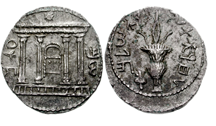
The rebels gathered all the Roman coins they could find, “filed off the original designs and restamped them with Jewish symbols and Hebrew inscriptions relating to their hope of rebuilding the Temple.” Some of the Year 1 coins bore the name of “Eleazar the Priest,” but going forward, all the remaining coins bore Simon’s name. The coins during the second year were labeled “Year Two of the Freedom of Israel.” During the third year, they were labeled “For the Freedom of Jerusalem.”15 Some depicted a temple, the ark of the covenant, and a messianic star.16
The Second Great Revolt, as noted by Professor Eric Orlin (University of Puget Sound), “had a clear religious nationalist element, centered upon a charismatic leader,” similar to the Zealot leadership of the First Great Revolt.17 Dr. Haggai Olshanetsky, ancient history researcher (University of Warsaw), refers to Simon as an “extremist self-aggrandizing zealot” who took the reins of leadership away from a group of unnamed Jewish veteran leaders.18 Robert Travers Herford (1860-1950), British scholar of rabbinical literature, also regarded Simon as a Zealot.19
Regarding “Eleazar the Priest,” whose name was on the earliest minted coins, historian Jona Lendering says that this “strongly suggests that a new high priest was elected” during the revolt.20
The prominence of the Sanhedrin was another parallel to the First Great Revolt some 65 years earlier. Doron Mendels, professor of history at the Hebrew University (Jerusalem), states that the Sanhedrin operated “as the sovereign high court for the Jewish population of Palestine” under Simon’s leadership.21 This Sanhedrin was housed at the military stronghold of Bethar “on a mountain ridge overlooking the road to Jerusalem” and at the site of Simon’s headquarters and the rebels’ last stand.22
As evidenced by the coins minted from AD 132-135, “the rebuilding of the Temple and the renewal of the service in the Temple were the main targets of the rebels.” Mendels believes that the rebels were pushing for the temple to be fully restored by the 70-year mark of Jerusalem’s desolation, i.e., by AD 140, as occurred “in the days after the destruction of the First Temple (cf. Zech 1:12 and 7:5; Jer 25:11-12; 29:10).”23 Some believe that a temple actually was rebuilt during the revolt, like Dr. Randall Price, Executive Director of the Center for Judaic Studies at Liberty University, who listed seven pieces of evidence for this occurrence in his 1999 book, The Coming Last Days Temple.24
Regarding John’s description of the nations at the four corners of the earth as “Gog and Magog” (Rev 20:8), I do not see this as a direct fulfillment of Ezekiel 38-39, which I believe was fulfilled in the days of Esther.25 Instead, “Gog and Magog” (Rev 20:8) can be viewed as analogous to the international coalition of adversaries who sought to annihilate the Jews in Esther’s day (Esth 3:6-15). Just as the enemies of the Jews failed to gain mastery over Esther’s people and were destroyed instead (Esth 9:1-16), Gog and Magog also sought to destroy God’s people in Jerusalem but were devoured instead of the saints (Rev 20:7-9).
Revelation 20:9
“And they came up on the broad plain of the earth and surrounded the camp of the saints and the beloved city, and
fire came down from heaven and devoured them” (Rev 20:9).
This language suggests a targeted persecution against Christians living transitorily in Jerusalem and divine retribution against their persecutors. The persecutors of God’s people would also be on the losing side of the war. This is exactly what history records happening during the Second Great Revolt.
The Broad Plain of the Earth
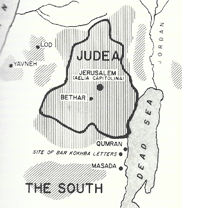
The “broad plain of the earth” (or land) is a fitting description of the territory upon which movement took place in the Second Great Revolt. Before and during the revolt, Simon and his men “controlled large amounts of land in the Judean hills, Judean desert and Bet Guvrin.”26 Both the Jews and the Romans “avoided a frontal clash in pitched battle…in the open field” in this war. The Roman general Julius Severus instead “made use of a cautious system of attrition and ‘nibbling away’ at the enemy…and his forces spread out over the breadth of Judea to destroy it.” The fighting “essentially was limited to Judea.” The Jewish rebels had “built underground networks of caves, storehouses, shelters, and hiding places.” As the war progressed, many took shelter in these places and moved progressively to the Judean and Hebron hills, with Simon’s last stand being at Bethar (about seven miles southwest of Jerusalem).27
(Harkabi, 1983, p. 48)
The Camp of the Saints and the Beloved City
According to the Jewish historian Berel Wein, Simon Bar Kokhba initially surrounded Jerusalem in order to force the Romans out.28 At this point, the camp of the saints and the beloved city were surrounded,29 as an encampment of Jewish Christians met in the ruins of Jerusalem after the First Great Revolt. Jeffrey Butz (Penn State University) writes that a group of Jewish followers of Jesus returned from Pella and established a Christian meeting place where the Upper Room had been.30 Between the two great revolts, 14 bishops oversaw the church there.31 According to Hegesippus and Eusebius, Symeon, the cousin of Jesus, led this congregation from Jerusalem to Pella in obedience to Jesus’ words (Matthew 24:15-20, Mark 13:14-19, Luke 21:20-23) and back to Jerusalem after the First Great Revolt.32 According to the Jewish historian Gedaliah Alon, the Roman emperor Hadrian took notice of this church when he visited Jerusalem in AD 130:
“When (Hadrian) went to the Holy City and saw it in ruins, except for one small Christian church, he gave orders that the whole city be rebuilt, save for the temple.”33
Soon after this visit, wrote Epiphanius (AD 310-403), Hadrian sent his envoy to oversee the rebuilding work, and he witnessed a great demonstration of faith:
“Aquila, while he was in Jerusalem, also saw the disciples of the disciples of the apostles flourishing in the faith and working great signs, healings, and other miracles. For they were such as had come back from the city of Pella to Jerusalem and were living there and teaching.”34
Thus, “the camp of the saints” is an appropriate description for those who returned from Pella to the “beloved city” and were flourishing in the faith as they lived and met among the city’s ruins. Then came the Second Great Revolt, and they became the chief target of the rebels, according to Justin Martyr (AD 100-165):
“For in the Jewish war which lately raged, Barchochebas, the leader of the revolt of the Jews, gave orders that Christians alone should be led to cruel punishments, unless they would deny Jesus Christ and utter blasphemy.”35
Richard Bauckham (University of St Andrew) points out that Justin Martyr wrote this testimony “no more than ten or twenty years after the events, and there are indications in his writings that he acquired information about the revolt from Jews who emigrated to Ephesus after the war.”36 According to Eusebius, Simon “killed the Christians with all kinds of persecutions, when they refused to help him against the Roman troops.”37
Fire from Heaven
Fire from heaven and flames of fire were trademarks of the leadership of the Second Great Revolt. The Midrash (Rabbinical homiletic interpretations of Torah) features two stories in which fire came down from heaven and surrounded Rabbi Akiva’s contemporaries as they taught from the Torah (Shir Hashirim Rabbah 1:52; Devarim 4:11; Chagiga 15a). Rabbi Akiva interpreted this phenomenon as resulting from the mystical “secrets of the merkava, which relates to the Divine Revelation.”38 According to the church father Jerome, Simon “kept fanning a lighted blade of straw in his mouth with puffs of breath so as to give the impression that he was spewing out flames.”39
As the Romans made their way to Bethar, they deprived Simon’s army of food and shut them up “to crush, exhaust and exterminate them” (Cassius Dio 69.13.3). They “razed to the ground” 50 of Judaea’s most important outposts and 985 of their most famous villages, killing 580,000 men in battles and raids. One killing method was fire: “[The] number of those that perished by famine, disease and fire was past finding out” (Cassius Dio 69.14.1).40
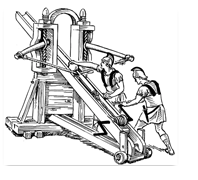
Bethar (believed to be the modern Palestinian village Battir) has not been systematically excavated, but the nearby site of Horbat ‘Etri, a walled village in the Judean foothills that participated in the war, is a prominent archaeological site. Bones and coins found there “attest to the brutality of the Romans’ policy of vastatio, that terrifying vengeance by steel and fire visited upon enemies of the RomanPeople.” Betar is widely believed to have endured the same type of direct assault by the Roman legions.41 With the “scorched-earth tactics” of the Roman forces,42 the direct assault of fire and steel, and the use of catapults and ballistae to launch weapons through the sky, “fire came down from heaven” is an apt description of the catastrophe at Bethar.
(Cartwright, 2014)43
There was perhaps an additional sense in which fire came down from heaven. The Roman emperor Hadrian did not take credit for killing Simon Bar Kokhba, instead declaring that God was responsible. When Simon’s head was brought to him, he stated: “If his God had not slain him, who could have overcome him?”44
Revelation 20:10
“And the devil who deceived them was thrown into the lake of fire and brimstone, where the beast and the false prophet
are also; and they will be tormented day and night forever and ever” (Rev 20:10).
It was the devil who deceived the persecutors of the saints, according to verse 10, earning him a permanent trip to the lake of fire. Notice who was already there: “…where the beast and the false prophet are also.” Therefore, it seems that the picture is clear if [1] the beast and false prophet were cast into the lake of fire at the time of the First Great Revolt [2] Satan was bound in the abyss at the end of the First Great Revolt, and [3] Satan was cast into the lake of fire at the end of the Second Great Revolt.
| Progressive Punishment of the War Leaders (the Beast, the False Prophet, and Satan) | ||
| Text | Event | Timing |
| Rev 12:9; 13:1-4, 11-13; 16:13-16 | Satan gave his authority, power, and throne to the beast; the second beast exercised all the authority of the first beast; Satan, the beast, and the false prophet – full of unclean spirits – gathered the nations to war. | AD 66-70 |
| Rev 19:20 | The beast and false prophet were captured and thrown in the lake of fire. | AD 70 |
| Rev 19:21 | The rest were killed and fed to the birds. | AD 70-73 |
| Rev 20:1-3 | Satan was captured and thrown into the abyss for 1000 years so that he could no longer deceive the nations. | AD 73-132 |
| Rev 20:7-9 | Satan was released from the abyss and again deceived the nations to war. | AD 132-135 |
| Rev 20:10 | Satan joined the beast and the false prophet in the lake of fire. | AD 135 |
Only after Satan’s second campaign of deceiving the nations was he thrown into the lake of fire, joining his “partners in crime” from the first campaign. Just as Satan gave his power, throne, and authority to the beast (Rev 13:2) in The First Great Revolt (AD 66-73), he likewise equipped the leaders of the Second Great Revolt (AD 132-135) after his release from the abyss. In summary, Satan deceived the nations in both of the great Jewish revolts against Rome, earning a temporary sentence to the abyss the first time and a permanent sentence to the lake of fire the second time. ♰
- Houdmann, M. (2011, April 8). What is the unholy trinity in the end times? GotQuestions.Org. https://www.gotquestions.org/unholy-trinity.html; Revelation 16:13 - Verse-by-Verse Bible Commentary. (n.d.). StudyLight.Org. https://www.studylight.org/commentary/revelation/16-13
- Cruickshank, Jr., R. (2025). Perspectives: The Millennium: AD 26 - 66. Fulfilled Communication Group; Fulfilled! Magazine. https://www.fulfilledcg.com/Magazine/previous-issues-2021-2025/2025-winter/rcj.htm
- Sedlak, J. (2022, April 12). Rethinking Revelation: A Thousand Years Without 20:5a. Academia. https://www.academia.edu/79044052/Rethinking_Revelation_A_Thousand_Years_Without_20_5a
- Morais, D. (n.d.). The Reference to a Second Resurrection of the Rest of the Dead in V. 5 is Not Found in the Earliest Manuscripts (ℵ 2030 2053 2062 MajK syrp). Revelation Revolution. https://www.revelationrevolution.org/the-reference-to-a-second-resurrection-of-the-rest-of-the-dead-in-v-5-is-not-found-in-the-earliest-manuscripts-ℵ-2030-2053-2062-majk-syrp/
- Lendering, J. (1998).Cassius Dio on Bar Kochba. Livius. https://www.livius.org/sources/content/cassius-dio/cassius-dio-on-bar-kochba/
- Lendering, J. (1998).Eusebius on Bar Kochba. Livius. https://www.livius.org/sources/content/eusebius/history-of-the-church/eusebius-on-bar-kochba/
- Lendering, J. (1998).Bar Kochba. Livius. https://www.livius.org/articles/concept/roman-jewish-wars/roman-jewish-wars-8/
- LLendering, J. (1998).Cassius Dio on Bar Kochba. Livius. https://www.livius.org/sources/content/cassius-dio/cassius-dio-on-bar-kochba/
- Lendering, J. (1998). Bar Kochba. Livius. https://www.livius.org/articles/concept/roman-jewish-wars/roman-jewish-wars-8/
- Contributors to Wikimedia projects. (2026, February 11). Jewish–Roman wars. Wikipedia. https://en.wikipedia.org/wiki/Jewish-Roman_wars
- Shimon Bar-Kokhba. (n.d.). Jewish Virtual Library. https://jewishvirtuallibrary.org/shimon-bar-kokhba
- Lendering, J. (1998). Eusebius on Bar Kochba. Livius. https://www.livius.org/sources/content/eusebius/history-of-the-church/eusebius-on-bar-kochba/
- Rabbi Akiva ben Joseph. (n.d.). Jewish Virtual Library. https://jewishvirtuallibrary.org/rabbi-akiva
- Horsley, R. A., and Hanson, J. S. (1985). Bandits, Prophets, and Messiahs: Popular Movements at the Time of Jesus. Harper & Row, pp. 128-129.
- Ancient Jewish Coins: Coins from the Second Revolt. (n.d.). Jewish Virtual Library. https://jewishvirtuallibrary.org/coins-from-the-second-revolt
- Lendering, J. (2020). “Coin of Bar Kochba (with Temple and Messianic Star).” Livius. https://www.livius.org/pictures/a/judaica/bar-kochba-coin/.
- Orlin, E. (2020). Judaea’s Leaderless Revolt Against Rome. TheTorah.Com. https://www.thetorah.com/article/judaeas-leaderless-revolt-against-rome
- Tercatin, R. (2025, May 16). Who really led the Bar Kochba revolt? New research sheds light on rebellion’s enigmas. The Times of Israel. https://www.timesofisrael.com/who-really-led-the-bar-kochba-revolt-new-research-sheds-light-on-rebellions-enigmas/
- Herford, R. T. (1928). Judaism in the New Testament Period. The Lindsey Press, p. 217.
- Lendering, J. (1998). Bar Kochba. Livius. https://www.livius.org/articles/concept/roman-jewish-wars/roman-jewish-wars-8/
- Mendels, D. (1992). The Rise and Fall of Jewish Nationalism: Jewish and Christian Ethnicity in Ancient Palestine. William B. Eerdmans Publishing Company, p. 390.
- The Bar-Kokhba Revolt (132-135 CE). (n.d.). Jewish Virtual Library. https://jewishvirtuallibrary.org/jsource/Judaism/revolt1.html; Oser, M. (2014, May 22). 10 Things You Need to Know About Shimon bar Kokhba. Streets of Israel. https://streetsofisrael.wordpress.com/2014/05/22/10-things-you-need-to-know-about-shimonbarkokhba/
- Mendels, D. (1992). The Rise and Fall of Jewish Nationalism: Jewish and Christian Ethnicity in Ancient Palestine. William B. Eerdmans Publishing Company, pp. 386-387, 390.
- 16.5.6. Bar Kochba’s Temple Commentary - A Testimony of Jesus Christ. (n.d.). Bible Study Tools. https://www.biblestudytools.com/commentaries/revelation/related-topics/bar-kochbas-temple.html
- See position A, articulated by David Lowman and Gary DeMar, in my article “Four Views of Gog and Magog”: https://adammaarschalk.com/2010/04/05/revelation-20-four-views-of-gog-and-magog/
- Shimon Bar-Kokhba. (n.d.). Jewish Virtual Library. https://jewishvirtuallibrary.org/shimon-bar-kokhba
- Harkabi, Y. (1983). The Bar Kokhba Syndrome: Risk and Realism in International Politics. Rossel Books (Library of Congress in Publication Data), pp. 31, 33, 37-38.
- Astor, B. W. (2010, July 6). Bar Kochba. Jewish History | We Bring Jewish History to Life. https://www.jewishhistory.org/bar-kochba/
- See Nehemiah 11:1; Psalm 78:68; Matthew 4:5, 27:53; etc.; also, consider Ecclesiasticus 24:11 (2nd century Jewish apocryphal wisdom literature): “Likewise in the beloved city he gave me rest, and in Jerusalem was my power.”
- Butz, J. (2009). The Secret Legacy of Jesus. Inner Traditions/Bear, p. 146.
- Agape Bible Study. (n.d.). EARLIEST BISHOPS OF THE CHURCH IN JERUSALEM. https://www.agapebiblestudy.com/charts/First%20Christian%20Bishops%20of%20Jerusalem.htm
- CHURCH FATHERS: Church History, Book III (Eusebius). (n.d.). https://www.newadvent.org/fathers/250103.htm; Philip Schaff: NPNF2-01. Eusebius Pamphilius: Church History - Christian Classics Ethereal Library. (n.d.). https://www.ccel.org/ccel/schaff/npnf201.iii.ix.xxii.html; Philip Schaff: NPNF2-01. Eusebius Pamphilius: Church History – Christian Classics Ethereal Library. (n.d.). https://ccel.org/ccel/schaff/npnf201.iii.viii.v.html
- Alon, G. (1980). “The Jews in Their Land in the Talmudic Age [AD 70-640].” Harvard University Press, p. 446 – quoting from Alexander Monachus, De Inventione Sanctae Crucis, p. 87, III, 4044-4045, published in 1620.
- Epiphanius of Salamis, Weights and Measures (1935), pp. 11-83. English translation. (n.d.). https://www.tertullian.org/fathers/epiphanius_weights_03_text.htm
- CHURCH FATHERS: The First Apology 31.6 (St. Justin Martyr) (n.d.). New Advent. https://www.newadvent.org/fathers/0126.htm
- Bauckham, R. (1998). Jews and Jewish Christians in the land of Israel at the time of the Bar Kochba war, with special reference to the Apocalypse of Peter. In G. N. Stanton & G. G. Stroumsa (Eds.), Tolerance and Intolerance in Early Judaism and Christianity (pp. 228–238). Cambridge: Cambridge University Press. https://www.cambridge.org/core/books/abs/tolerance-and-intolerance-in-early-judaism-and-christianity/jews-and-jewish-christians-in-the-land-of-israel-at-the-time-of-the-bar-kochba-war-with-special-reference-to-the-apocalypse-of-peter/5709D2B7B2EA75EAAEC33BE16CCCDDC9
- Lendering, J. (2000). Eusebius on Bar Kochba. Livius. https://www.livius.org/sources/content/eusebius/chronicle/eusebius-on-bar-kochba/
- Orlian, R. M. (n.d.). The Joyous Fire of Torah, Rav Meir Orlian - Torah. Yeshivat Kerem B’Yavneh. https://www.kby.org/english/torat-yavneh/view.asp?id=3979
- Lendering, J. (1998). Jerome on Bar Kochba. Livius. https://www.livius.org/sources/content/jerome-on-bar-kochba/
- Lendering, J. (1998). Cassius Dio on Bar Kochba. Livius. https://www.livius.org/sources/content/cassius-dio/cassius-dio-on-bar-kochba/
- Powell, L. (2021, November 4). Bar Kokhba: The Rebel Against Rome Whose Legend Helped Found a Nation. History Hit. https://www.historyhit.com/bar-kokhba-the-rebel-against-rome/
- Mitchell, R. (2024, August 18). Roman Fury: Crushing the Bar Kokhba Revolt. Ancient Origins: Unraveling the Mysteries of the Past. https://www.ancient-origins.net/news-history/bar-kokhba-revolt-0021286
- Cartwright, M. (2014). Roman Artillery. World History Encyclopedia. https://www.worldhistory.org/article/649/roman-artillery/
- Yadin, Y. (1971). Bar-Kokhba: The Rediscovery of the Legendary Hero of the Last Jewish Revolt Against Imperial Rome. Wiedenfeld and Nicolson, p. 8.
Comments:
Your honest review will help others in their search for truth. If you must leave a negative review please be gracious.
Rather, speaking the truth in love, we are to grow up in every way into him who the head, into Christ . . . .
(Ephesians 4:15)
We use "Disqus" commenting software. If you are not familiar with "Disqus," click here for more information. You don't need a Disqus account to post comments, however, without an account you won't be notified if someone responds to your post.